

Introduction: Why SEO Is the Highest-ROI Marketing Channel for Personal Injury Lawyers
If you’re a personal injury lawyer trying to grow your practice, you already know the economics: a single signed auto accident case can be worth $10,000–$80,000+ in contingency fees. Every qualified lead matters. The question isn’t whether you should invest in marketing, it’s which channel gives you the best return.
This guide makes the case that SEO (Search Engine Optimization) is the channel. Not because it’s the flashiest, or the fastest, but because it’s the only marketing strategy that gets cheaper and more powerful the longer you do it.
Billboards, TV ads, and pay-per-click (PPC) campaigns are the marketing equivalent of renting. The moment you stop paying, the leads stop. SEO is more like buying property. The content and authority you build today continue to attract clients for years, at a decreasing cost per acquisition.
What You Will Learn in This Guide
- How to rank your firm in your city and keep that position
- How to find the exact keywords your ideal clients are typing right now
- How to optimize every element of your website without needing a developer
- How to dominate the Google Maps ‘Local Pack’.
- How to measure ROI so you know your investment is working
- How SEO compares in real cost to Google Ads, LSA, and lead generation services
- The most common objections lawyers have to SEO and why they’re worth revisiting
| Who This Guide Is For: This guide is written for personal injury lawyers who want to understand or personally execute SEO, and for lawyers evaluating whether to hire an SEO specialist. No technical background is required. Every step is explained plainly. |
Setting Realistic Expectations: An Honest SEO Timeline
One of the most important things to understand before investing in SEO is that it is a medium- to long-term growth channel. Results are real, measurable, and compounding, but they are not instant. Here is what a realistic timeline looks like for a personal injury law firm.
| Phase / Timeline | What’s Happening | Realistic Expectations |
| Month 1 (Foundation) | Audit, keyword research, website fixes, GBP setup, citations | No visible traffic changes yet; this is prep work |
| Months 2–3 (Early Gains) | Content creation, on-page optimization, schema setup, and first backlinks | Rankings start moving from page 4–5 to page 2–3. Occasional organic calls begin |
| Months 4–6 (Traction) | Consistent blogging, review building, link outreach | First-page appearances for mid-competition keywords. Regular inquiry volume |
| Months 7–12 (Compounding) | Ongoing content, authority building, conversion optimization | Consistent top-3 rankings for high-intent terms. Predictable lead flow |
| Year 2+ (Dominance) | Expansion to new practice areas, satellite cities, and thought-leadership content | Reduced cost per lead vs. PPC. Compounding organic growth |
| Important Note: These timelines assume consistent execution. Firms that publish one blog post and wait 90 days will see no results. The compounding effects of SEO require compounding inputs: regular content, ongoing link building, and monthly review management. |
The Real Cost of Getting a Client: SEO vs. Paid Alternatives
Before diving into the how-to steps, it’s worth understanding exactly where SEO sits relative to the other ways personal injury firms buy clients. The numbers below are based on industry benchmarks for competitive legal markets in the US.
| Metric | Google Ads (PPC) | LSA Ads | Lead Gen Services | SEO (Organic) |
| Avg. Cost Per Click (CPC) | $50–$300 | N/A (per lead) | N/A | $0 per click |
| Avg. Cost Per Lead | $200–$1,200 | $150–$800 | $200–$1,500 | $30–$150 (mature) |
| Avg. Cost Per Signed Case | $1,500–$5,000+ | $800–$3,000 | $1,000–$4,000 | $200–$800 (mature) |
| Traffic Stops If You Stop Paying? | Yes — immediately | Yes — immediately | Yes — immediately | No — rankings persist |
| Long-Term ROI Trajectory | Flat or rising costs | Competitive, rising | High & unpredictable | Decreasing cost over time |
| Lead Exclusivity | No (competitor ads too) | Usually exclusive | Often shared 3–5 firms | Yes — only your site ranks |
Data Source: FirstPageSage
The key insight is in the bottom rows. With PPC, LSA, and lead gen services, you’re renting traffic. When the payment stops, the pipeline dries up immediately. With SEO, you’re building an asset. A page that ranks #1 for ‘car accident lawyer Las Vegas’ will continue to generate calls whether you pay this month or not.
For a firm closing 10–15% of leads into cases, even a modest SEO campaign generating 30 organic leads per month at $100/lead equals $3,000 in acquisition cost vs. $30,000–$45,000 for the same volume through PPC.
Before You Start: What You Need to Have Ready
Don’t worry if your website is outdated or your online presence is minimal. The point of this guide is to build and improve, starting from wherever you are. But having these items ready will help you move faster:
- A documented list of your practice areas (not just ‘personal injury’ but car accidents, truck accidents, slip and fall, wrongful death, dog bite, etc.)
- Your target service area, primary city, nearby cities, counties, and the suburbs you serve
- A website, even a basic, older one. You’ll improve it through this process
- Access to your website’s backend
- A Google account for Google Search Console and Google Business Profile
Step 1: Define Your Services and Target Locations
This is the foundation of your entire SEO strategy. Google needs to understand with absolute clarity what types of cases you handle and where you handle them. This step turns vague positioning into a precise targeting map.
1A — List Your Practice Areas (Be Specific)
Most lawyers list ‘personal injury’ and call it a day. That’s the equivalent of a restaurant listing their menu as ‘food.’ The more specific you are, the more precisely Google can match you to the right searcher.
Example practice area list for a personal injury firm:
- Car Accident Lawyer
- Truck Accident Lawyer
- Motorcycle Accident Lawyer
- Slip and Fall Lawyer
- Wrongful Death Lawyer
- Pedestrian Accident Lawyer
- Dog Bite Lawyer
- Rideshare Accident Lawyer (Uber/Lyft)
- Traumatic Brain Injury (TBI) Lawyer
- Workplace Injury Lawyer
- Spinal Cord Injury Lawyer
1B — Define Your Target Locations
Be specific about the geography you serve. For example, if your office is in Las Vegas, your target location list might look like:
- Las Vegas (primary)
- Henderson
- North Las Vegas
- Summerlin
- Spring Valley
- Clark County (county-level page)
| SEO Tip: People search for hyper-specific combinations. ‘Car accident lawyer Henderson NV’ is a different keyword from ‘car accident lawyer Las Vegas.’ Build your strategy around Service + Location combinations — that’s how real clients search. |
✅ Step Complete — You Now Have:
|
Step 2: Analyze Your Competitors
Your competitors have already done years of market testing for you. Analyzing who ranks on page one tells you exactly what Google rewards in your city. Don’t guess, reverse-engineer what’s already working.
2A — Manual Google Search
Search your primary keyword exactly as a client would: ‘personal injury lawyer [your city]’. Skip the paid ads at the top. Open the top 3–5 organic websites and the top 3 Google Maps listings.
2B — What to Look For
On each competitor’s site, check the following:
- Navigation/menu: What practice area pages do they have? How many dedicated pages?
- Homepage headline: Example: ‘Las Vegas Personal Injury Lawyer, Free Consultation & No Upfront Fees.’ What promise does it make?
- Offer/CTA: ‘No fee unless we win,’ ’24/7 availability,’ ‘Free case review.’ What are they leading with?
- Google reviews: Rating + volume. 4.5 stars with 150+ reviews is competitive. Read the reviews for client language you can use in your own copy.
- Content depth: Are their service pages 300 words or 2,000 words? Deeper content usually signals the ranking floor you need to match or beat.
2C — Use Free Tools
Go to ubersuggest.com and enter a top competitor’s domain. You’ll see:
- Which keywords bring them the most traffic
- Which pages receive the most visitors (tells you what content to prioritize)
- Their domain authority score (how hard it will be to outrank them)
| SEO Tip: Don’t copy competitors, adapt and exceed them. Find the pages they haven’t built (e.g., rideshare accident, electric scooter injury) and create those first. Gap-filling is one of the fastest ways to gain rankings. |
✅ Step Complete — You Now Have:
|
Step 3: Keyword Research, What Your Clients Are Actually Searching
Keywords are the exact phrases an injured person types into Google while they’re scared, in pain, and looking for help. Your job is to be the first answer they see.
Keyword Categories for Personal Injury Firms
Organize your keywords by intent. This determines where and how you’ll use each one:
- High-Intent Service Keywords (Ready to hire now)
- personal injury lawyer Las Vegas
- car accident attorney Las Vegas, NV
- truck accident lawyer Henderson
- slip and fall lawyer near me
- wrongful death attorney Las Vegas
- Location + Service Variations
- Injury Lawyer Las Vegas, NV
- Las Vegas personal injury attorney free consultation
- best personal injury lawyer in Henderson
- Question / Informational Keywords (Research phase)
- How much is my car accident settlement worth
- What to do after a car accident in Nevada
- Do I need a lawyer for a minor accident
- How long does a personal injury case take in Nevada
- Can I sue if I was partially at fault in Nevada
- Comparison / Evaluation Keywords
- personal injury lawyer vs insurance settlement
- Should I hire a personal injury lawyer
- contingency fee personal injury lawyer Las Vegas
How to Find More Keywords
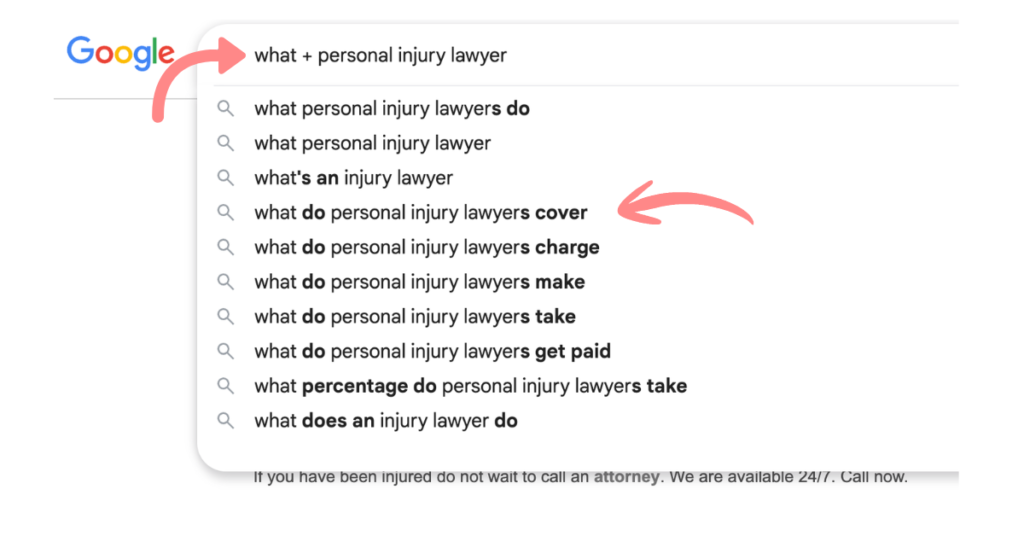
Method 1: Google Search Autocomplete:
Type your primary service into Google and stop before pressing Enter. The dropdown suggestions are real searches from real users. Repeat with ‘what,’ ‘how,’ ‘when,’ and ‘why’ prefixes.
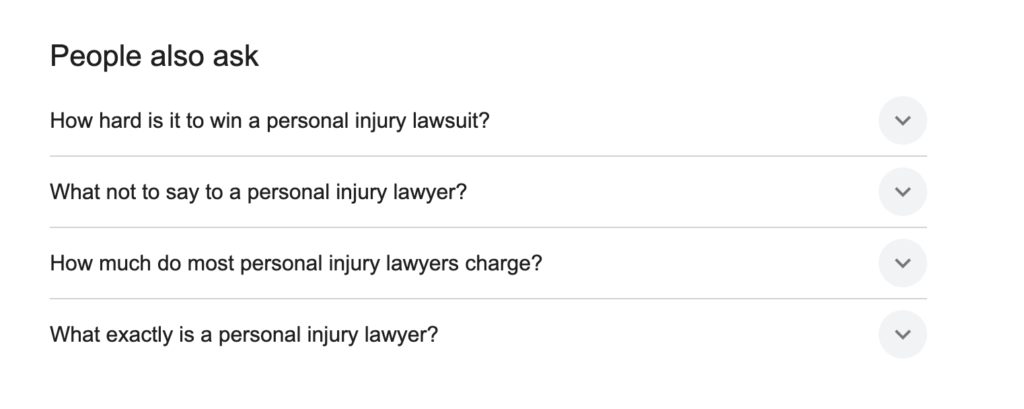
Method 2: ‘People Also Ask’ and ‘Related Searches’:
After your search, scroll down the results page. Google surfaces these because real users search for them. Every ‘People Also Ask’ question is a potential blog post or FAQ entry.
Method 3: Ubersuggest or Google Keyword Planner:
Enter your seed keywords, filter for local volume, and export your list. Sort by intent and difficulty.
| SEO Tip: For a competitive market like personal injury law, start with mid-tail keywords (3–5 words, specific but not overly niche) like ‘car accident lawyer Henderson NV’ rather than head terms like ‘injury lawyer’ (dominated by national brands) or ultra-long-tails with zero search volume. |
✅ Step Complete — You Now Have:
|
Step 4: Plan Your Website Architecture
Your website structure is your SEO blueprint. It tells Google what you do, where you do it, and what’s most important. A well-organized site is also easier for injured clients to navigate, which improves conversions.
Core Pages (Non-Negotiable)
- Homepage: Your firm overview, primary city keyword, and main CTA
- About Us / Team: Attorney bios with credentials, bar admissions, and case experience
- Contact: Phone, address, map embed, and a simple contact form
- Results / Case Wins: Settlements and verdicts (check your state Bar rules on advertising case results)
Service Pages (One Page Per Practice Area)
Never combine multiple services on one page. Each page targets one primary keyword:
- Car Accident Lawyer Las Vegas
- Truck Accident Lawyer Las Vegas
- Slip and Fall Lawyer Las Vegas
- Wrongful Death Lawyer Las Vegas
- Motorcycle Accident Lawyer Las Vegas
- Rideshare Accident Lawyer Las Vegas
Location Pages (One Page Per City You Serve)
- Personal Injury Lawyer Henderson
- Personal Injury Lawyer North Las Vegas
- Personal Injury Lawyer Summerlin
Blog / Resource Pages
- What to Do After a Car Accident in Nevada (Step-by-Step)
- How Long Does a Personal Injury Settlement Take in Nevada?
- Nevada Comparative Negligence Law: What It Means for Your Case
- Average Car Accident Settlement in Nevada
| SEO Tip: One page = one keyword. Never try to rank your homepage for ‘truck accidents’ and ‘dog bites.’ Each page should be laser-focused on a single primary keyword, supported by closely related variations. |
✅ Step Complete — You Now Have:
|
Step 5: Build or Improve Your Website
Your website has one job: turn visitors into phone calls and case inquiries. Technical performance and conversion design both matter equally here.
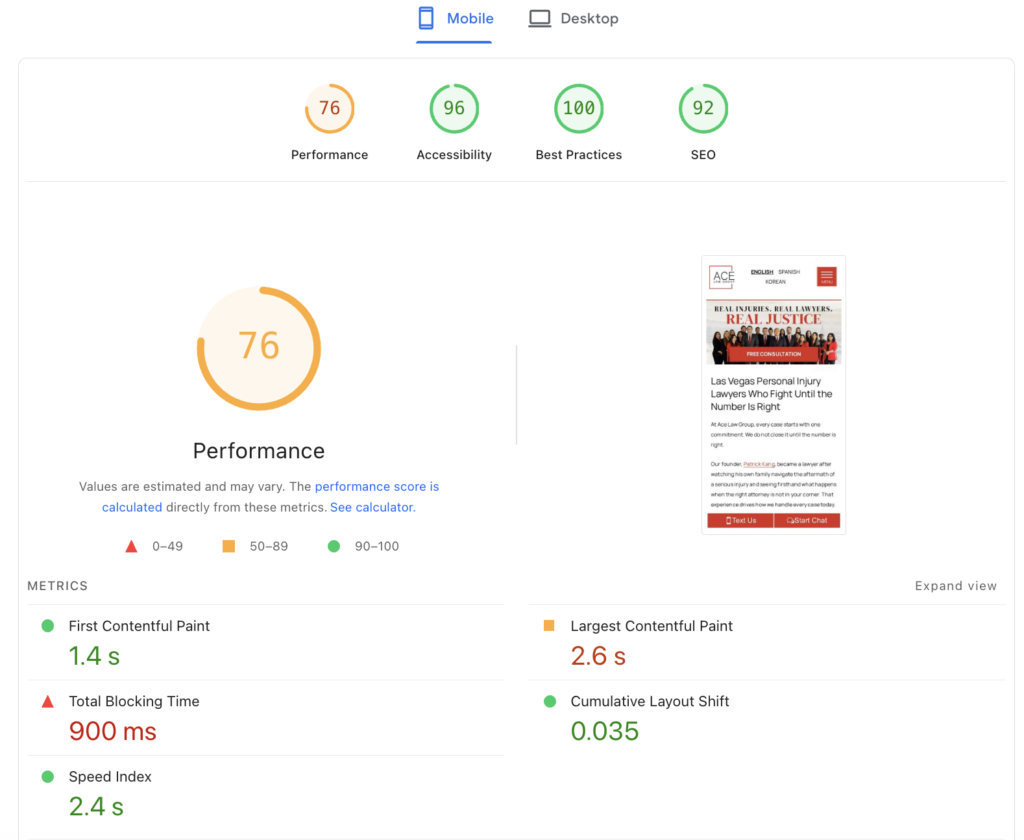
Website Speed:
Test at pagespeed.web.dev. Enter your URL and aim for a score above 70 on mobile. Common issues in law firm sites: uncompressed images, slow shared hosting, excessive plugins. Speed is a ranking signal; slow sites lose rankings and visitors.
Mobile Optimization:
Over 65% of personal injury searches happen on smartphones, often at the scene of an accident or right after. Test your site on a real mobile device. Check:
- Text is readable without zooming
- Buttons are easy to tap with a thumb
- Phone number is prominently visible, and click-to-call is enabled
- No horizontal scrolling or content overlap
Conversion Elements Every Law Firm Site Needs:
- Sticky click-to-call phone number (visible even while scrolling)
- ‘Free Consultation’ button in a contrasting color above the fold
- Short contact form, Name, Phone, Email, ‘What happened?’ (5 fields max)
- Live chat widget (optional but powerful for late-night researchers)
Trust Signals:
Personal injury law is a high-stakes, high-trust category. Establish credibility immediately:
- Client testimonials with full names (with permission) or video reviews
- Attorney credentials: Bar memberships, certifications, trial experience
- Case results with settlement amounts (check your state Bar rules)
- Association badges: Super Lawyers, Avvo, Martindale-Hubbell, State Bar logos
- Years in practice and the number of cases handled
| SEO Tip: A fast, mobile-optimized site with clear trust signals doesn’t just help you rank — it dramatically increases the percentage of visitors who actually call. Traffic without conversion is a wasted ranking. |
✅ Step Complete — You Now Have:
|
Step 6: Create Deep, Comprehensive SEO Content
Content is how Google decides whether your site deserves to rank. Not keyword density, not meta tags alone, but genuinely useful, deep, well-structured content that fully answers what an injured person is searching for.
What a Strong Service Page Looks Like
Example: Your ‘Car Accident Lawyer Las Vegas’ page should include all of the following:
- H1 headline: ‘Car Accident Lawyer in Las Vegas – Free Consultation.’
- Opening paragraph: What you do, who you help, your key differentiator
- Why hire a lawyer: The insurance tactics that hurt unrepresented victims
- Your process: From free consultation to settlement/verdict
- Types of car accident cases you handle: Rear-ends, hit-and-runs, drunk drivers, commercial vehicles, rideshares, uninsured drivers
- Nevada-specific information: Statute of limitations (2 years), comparative fault rules, no-fault vs at-fault state details
- Compensation you can recover: Medical bills, lost wages, pain and suffering, property damage, future care costs
- Client testimonials specific to car accident cases
- FAQ section (minimum 5 questions)
- Clear CTA: ‘Call now for a free case review, no fee unless we win.’
- Internal links to related pages (truck accidents, motorcycle accidents, contact page)
Example FAQ Questions for a Car Accident Page
- How long do I have to file a car accident lawsuit in Nevada?
- What if the other driver was uninsured?
- Can I still recover damages if I was partly at fault?
- How long does it take to settle a car accident case?
- What is my car accident case worth?
Blog Content Strategy
Use your question keywords from Step 3 as blog topics. Each blog post answers one specific question comprehensively. Target posts:
- What to Do Immediately After a Car Accident in Nevada (Checklist)
- Nevada Comparative Fault: Can You Sue If You Were Partially At Fault?
- Average Settlement for Whiplash in Nevada: What to Expect
- How Insurance Companies Undervalue Personal Injury Claims (And What To Do About It)
- Slip and Fall on Private Property in Nevada: Do You Have a Case?
Content Writing Guidelines
- Write at an 8th-grade reading level, use plain English, not legalese
- Keep paragraphs to 2–3 sentences on desktop (single sentence on mobile)
- Answer the main question in the first paragraph, then elaborate
- Use numbered lists and bullet points to organize complex information
- Add H2 and H3 subheadings every 200–300 words for scannability
- Aim for 1,500–3,000 words on primary service pages; 1,000–1,500 for blog posts
| SEO Tip: Google’s ranking systems reward topical depth and genuine helpfulness. A single 2,500-word page that comprehensively covers every aspect of car accident claims in your city will outperform five shallow 500-word pages on the same topic. |
✅ Step Complete — You Now Have:
|
Step 7: On-Page SEO Optimization
On-page SEO is the process of configuring individual page elements so Google can read, understand, and categorize your content correctly. Think of it as labeling the filing cabinet, so Google doesn’t have to guess.
Title Tags:
The title tag is the clickable blue link that appears in Google search results. It’s one of the strongest on-page ranking signals.
- Format: Primary Keyword | Supporting Keyword | Firm Name
- Example: Car Accident Lawyer Las Vegas | Free Consultation | Smith Injury Law
- Length: Keep under 60 characters to avoid truncation in search results
Meta Descriptions:
Not a direct ranking factor, but it heavily influences click-through rate, which affects rankings indirectly.
- Write a 140–155 character summary that includes your keyword and a clear CTA
- Example: ‘Injured in a Las Vegas car accident? Smith Injury Law offers free consultations and no fee unless you win. Call 24/7 for immediate help.’
URL Structure:
- Good: yourlawfirm.com/car-accident-lawyer-las-vegas
- Bad: yourlawfirm.com/services/page?id=492 or yourlawfirm.com/prac-areas/ca-lv
- Keep URLs short, descriptive, and hyphen-separated. No underscores.
Heading Hierarchy (H1, H2, H3):
- H1: One per page, contains primary keyword. Example: ‘Car Accident Lawyer in Las Vegas’
- H2: Section headers for major content blocks. Example: ‘What to Do After a Car Accident in Nevada’
- H3: Subpoints within H2 sections. Example: ‘Documenting the Scene’
Internal Linking:
- Every service page should link to your contact page
- Every blog post should link to at least one relevant service page
- Use descriptive anchor text: ‘Our Las Vegas truck accident lawyers, ‘ not ‘click here.’
Image Optimization:
- File names: Use descriptive names before uploading. ‘las-vegas-car-accident-lawyer.jpg’ not ‘IMG_3829.jpg’
- Alt text: Add a short description to every image so Google understands the visual
- File size: Compress images before uploading. Target under 200KB per image.
| SEO Tip: If your site runs on WordPress, install RankMath or Yoast SEO. These plugins walk you through title tags, meta descriptions, schema, and sitemaps — all in a simple interface. No coding required. |
✅ Step Complete — You Now Have:
|
Step 8: Optimize Your Google Business Profile
Your Google Business Profile (GBP) is arguably the single most impactful SEO asset for a local personal injury firm. It controls whether you appear in the ‘Local Pack’ on the map and three business listings that appear above all organic results for local searches. High-intent clients who are ready to call right now are looking at the Map Pack first.
Setting Up and Claiming Your Profile
Go to google.com/business. If you have an existing profile, claim it. If not, create one. Google will require a verification step, usually a postcard with a code sent to your office address.
Core Profile Optimization
- Business name: Your exact legal DBA. No keyword stuffing unless it’s your actual firm name.
- Primary category: ‘Personal Injury Attorney’ (be specific, not just ‘Lawyer’ or ‘Law Firm’)
- Secondary categories: Law Firm, Legal Services, Trial Attorney (up to 5 total)
- Address: Must match your website and all directory listings exactly
- Phone number: Local number preferred over 800 numbers for local SEO
- Website: Link to your homepage
- Hours: Keep accurate and mark holiday hours when applicable
Profile Content Optimization
- Description (750 characters): Write naturally, weaving in 2–3 target keywords. Example: ‘Smith Injury Law has represented Las Vegas personal injury victims for over 15 years. Our car accident, slip and fall, and wrongful death attorneys work on contingency; you pay nothing unless we win.’
- Services tab: Manually list each practice area with a short description
- Photos: Add exterior shots (helps clients find you), office interior, attorney headshots, and team photos. Google rewards active profiles with more visibility.
- Google Posts: Publish a short update or offer weekly. ‘Free consultation for new injury cases in Las Vegas. Call today.’ Keeps your profile active.
Reviews: The Local Pack’s #1 Ranking Factor
Google uses review quantity, recency (velocity), and score as primary local ranking signals. A firm with 200 reviews and a 4.8 rating almost always outranks a firm with 20 reviews and a 5.0 rating.
- Ask for reviews at case close. The best moment is when you hand over the settlement check
- Send a direct review link via SMS or email immediately after case resolution
- Respond to every review, both positive and negative, professionally
- Target: Reach 50 Google reviews before anything else for Map Pack competitiveness
| SEO Tip: Google Maps results sit above all organic website results for local searches. A firm with a strong GBP but a mediocre website will often outperform a firm with a great website and a weak GBP. Both matter, but optimize GBP first. |
✅ Step Complete — You Now Have:
|
Step 9: Technical SEO, Making Your Site Google-Readable
Imagine you’ve built a stunning new law office with 20 years of trophies and testimonials on the walls. But if the front door is locked and there’s no sign out front, no clients will ever walk in. Technical SEO is the equivalent of unlocking the door, putting up the sign, and making sure the address is correct in Google Maps.
Even a beautiful website can be invisible to Google if technical errors prevent it from being read, crawled, and indexed. None of these steps requires coding; they require following a checklist.
1. Schema Markup (Structured Data):
Schema is a small piece of hidden code that tells Google explicitly: ‘This is a Personal Injury Law Firm in Las Vegas. Here is the phone number, hours, and address.’ Without a schema, Google has to guess from reading your content. With schema, there’s no ambiguity.
The easy way (WordPress): Install RankMath. Go to Local SEO settings. Fill in your firm name, logo, address, phone, and hours. The plugin generates and inserts the code automatically.
The manual way: Go to technicalseo.com/tools/schema-markup-generator. Select ‘Legal Service.’ Fill in your details, copy the JSON-LD code, and paste it in the <head> section of your website pages.
Schema types to add: LocalBusiness, LegalService, Attorney, FAQPage (for FAQ sections), BreadcrumbList.
This is an example of the Schema Code for personal injury law:
// <script type="application/ld+json">
{
  "@context": "https://schema.org",
  "@graph": [
    {
      "@type": "LegalService",
      "@id": "https://www.vegasinjuryadvocates.com/#legalservice",
      "name": "Vegas Injury Advocates",
      "url": "https://www.vegasinjuryadvocates.com/",
      "logo": "https://www.vegasinjuryadvocates.com/wp-content/uploads/logo.png",
      "image": "https://www.vegasinjuryadvocates.com/wp-content/uploads/personal-injury-lawyers-las-vegas.jpg",
      "description": "Vegas Injury Advocates is a personal injury law firm in Las Vegas helping accident victims with car accidents, truck accidents, motorcycle accidents, slip and fall injuries, wrongful death claims, and other injury cases.",
      "telephone": "+1-702-555-0199",
      "email": "info@vegasinjuryadvocates.com",
      "priceRange": "$$$",
      "currenciesAccepted": "USD",
      "paymentAccepted": "Cash, Credit Card, Check",
      "address": {
        "@type": "PostalAddress",
        "streetAddress": "400 S 4th Street Suite 500",
        "addressLocality": "Las Vegas",
        "addressRegion": "NV",
        "postalCode": "89101",
        "addressCountry": "US"
      },
      "geo": {
        "@type": "GeoCoordinates",
        "latitude": "36.1663",
        "longitude": "-115.1438"
      },
      "areaServed": [
        {
          "@type": "City",
          "name": "Las Vegas"
        },
        {
          "@type": "City",
          "name": "North Las Vegas"
        },
        {
          "@type": "City",
          "name": "Henderson"
        },
        {
          "@type": "AdministrativeArea",
          "name": "Clark County"
        }
      ],
      "openingHoursSpecification": [
        {
          "@type": "OpeningHoursSpecification",
          "dayOfWeek": [
            "Monday",
            "Tuesday",
            "Wednesday",
            "Thursday",
            "Friday"
          ],
          "opens": "08:00",
          "closes": "18:00"
        }
      ],
      "sameAs": [
        "https://www.facebook.com/vegasinjuryadvocates",
        "https://www.linkedin.com/company/vegasinjuryadvocates",
        "https://www.instagram.com/vegasinjuryadvocates"
      ],
      "hasOfferCatalog": {
        "@type": "OfferCatalog",
        "name": "Personal Injury Legal Services",
        "itemListElement": [
          {
            "@type": "Offer",
            "itemOffered": {
              "@type": "LegalService",
              "name": "Car Accident Lawyer Las Vegas",
              "url": "https://www.vegasinjuryadvocates.com/car-accident-lawyer-las-vegas/"
            }
          },
          {
            "@type": "Offer",
            "itemOffered": {
              "@type": "LegalService",
              "name": "Truck Accident Lawyer Las Vegas",
              "url": "https://www.vegasinjuryadvocates.com/truck-accident-lawyer-las-vegas/"
            }
          },
          {
            "@type": "Offer",
            "itemOffered": {
              "@type": "LegalService",
              "name": "Motorcycle Accident Lawyer Las Vegas",
              "url": "https://www.vegasinjuryadvocates.com/motorcycle-accident-lawyer-las-vegas/"
            }
          },
          {
            "@type": "Offer",
            "itemOffered": {
              "@type": "LegalService",
              "name": "Slip and Fall Lawyer Las Vegas",
              "url": "https://www.vegasinjuryadvocates.com/slip-and-fall-lawyer-las-vegas/"
            }
          },
          {
            "@type": "Offer",
            "itemOffered": {
              "@type": "LegalService",
              "name": "Wrongful Death Lawyer Las Vegas",
              "url": "https://www.vegasinjuryadvocates.com/wrongful-death-lawyer-las-vegas/"
            }
          }
        ]
      }
    },
    {
      "@type": "WebSite",
      "@id": "https://www.vegasinjuryadvocates.com/#website",
      "url": "https://www.vegasinjuryadvocates.com/",
      "name": "Vegas Injury Advocates",
      "publisher": {
        "@id": "https://www.vegasinjuryadvocates.com/#legalservice"
      },
      "potentialAction": {
        "@type": "SearchAction",
        "target": "https://www.vegasinjuryadvocates.com/?s={search_term_string}",
        "query-input": "required name=search_term_string"
      }
    },
    {
      "@type": "WebPage",
      "@id": "https://www.vegasinjuryadvocates.com/personal-injury-lawyer-las-vegas/#webpage",
      "url": "https://www.vegasinjuryadvocates.com/personal-injury-lawyer-las-vegas/",
      "name": "Personal Injury Lawyer Las Vegas",
      "description": "Speak with experienced personal injury lawyers in Las Vegas for accident claims, injury compensation, and legal support after an accident.",
      "isPartOf": {
        "@id": "https://www.vegasinjuryadvocates.com/#website"
      },
      "about": {
        "@id": "https://www.vegasinjuryadvocates.com/#legalservice"
      },
      "primaryImageOfPage": {
        "@type": "ImageObject",
        "url": "https://www.vegasinjuryadvocates.com/wp-content/uploads/personal-injury-lawyer-las-vegas.jpg"
      }
    },
    {
      "@type": "BreadcrumbList",
      "@id": "https://www.vegasinjuryadvocates.com/personal-injury-lawyer-las-vegas/#breadcrumb",
      "itemListElement": [
        {
          "@type": "ListItem",
          "position": 1,
          "name": "Home",
          "item": "https://www.vegasinjuryadvocates.com/"
        },
        {
          "@type": "ListItem",
          "position": 2,
          "name": "Personal Injury Lawyer Las Vegas",
          "item": "https://www.vegasinjuryadvocates.com/personal-injury-lawyer-las-vegas/"
        }
      ]
    },
    {
      "@type": "FAQPage",
      "@id": "https://www.vegasinjuryadvocates.com/personal-injury-lawyer-las-vegas/#faq",
      "mainEntity": [
        {
          "@type": "Question",
          "name": "How much does a personal injury lawyer cost in Las Vegas?",
          "acceptedAnswer": {
            "@type": "Answer",
            "text": "Many personal injury lawyers work on a contingency fee basis, which means clients usually pay legal fees only if compensation is recovered."
          }
        },
        {
          "@type": "Question",
          "name": "What cases do personal injury lawyers handle?",
          "acceptedAnswer": {
            "@type": "Answer",
            "text": "Personal injury lawyers commonly handle car accidents, truck accidents, motorcycle accidents, pedestrian accidents, slip and fall injuries, dog bites, workplace injuries, and wrongful death cases."
          }
        },
        {
          "@type": "Question",
          "name": "Should I call a lawyer after a car accident in Las Vegas?",
          "acceptedAnswer": {
            "@type": "Answer",
            "text": "It is helpful to speak with a lawyer after an accident, especially if there are injuries, medical bills, lost wages, insurance issues, or questions about fault."
          }
        }
      ]
    }
  ]
}
</script>
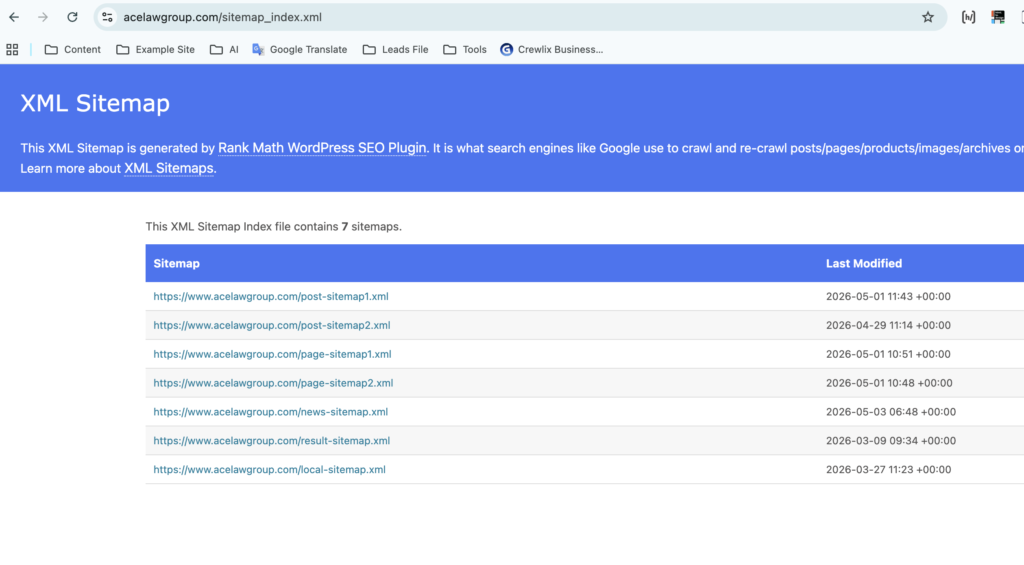
2. XML Sitemap:
A sitemap is an auto-generated file that lists every page on your website. It acts as a table of contents for Google’s crawlers, ensuring no pages get missed. RankMath creates this automatically. Submit it in Google Search Console under ‘Sitemaps.’
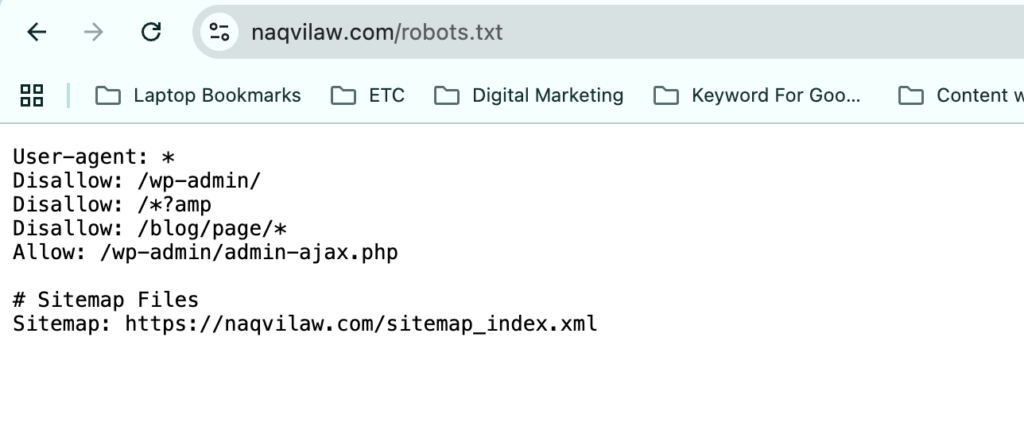
3. Robots.txt Check
This file tells Google’s bots what to crawl and what to ignore. Developers sometimes accidentally block important pages. Check yours at yourdomain.com/robots.txt. Ensure there’s no ‘Disallow: /’ blocking the whole site or key service pages.
4. Google Search Console Setup
Create a free account at search.google.com/search-console. Verify your domain, submit your sitemap, and use it to monitor: which keywords bring traffic, crawl errors, indexing issues, and mobile usability problems. Check it monthly at a minimum.
5. Core Web Vitals
Google measures actual user experience with metrics called Core Web Vitals: Largest Contentful Paint (how fast the main content loads), Cumulative Layout Shift (how stable the page is as it loads), and Interaction to Next Paint (how quickly the page responds to clicks). Check these in Google Search Console or PageSpeed Insights. Law firm sites often fail on LCP due to large hero images that compress them.
| SEO Tip: Technical SEO is a one-time setup that you revisit quarterly. The biggest wins usually come from fixing Core Web Vitals, setting up schema, and verifying that Google can actually index all your service pages. Use the free Screaming Frog SEO Spider (crawls up to 500 pages free) for a full site audit. |
✅ Step Complete — You Now Have:
|
Step 10: Build Local Citations and Directory Listings
A citation is any online mention of your firm’s Name, Address, and Phone number (NAP). Citations act like background checks for Google; the more consistently your firm appears across the internet, the more confident Google is that you’re a legitimate, established local business.
Top Directories for Personal Injury Lawyers
General directories:
- Google Business Profile (covered in Step 8)
- Yelp, Bing Places, Apple Maps, Yellow Pages, Better Business Bureau (BBB)
Legal-specific directories (high-authority):
- Avvo.com: Create a full profile, add your credentials, request reviews
- Justia.com: Free lawyer profiles, high domain authority
- FindLaw.com: Premium placement available; free basic listing
- Martindale-Hubbell: Legacy legal directory, still widely trusted
- Nolo.com: Also popular for legal consumer information
- Lawyers.com: Martindale’s consumer-facing site
The Critical NAP Consistency Rule
This is where most law firms inadvertently hurt their local SEO. Your Name, Address, and Phone number must be absolutely identical across every listing on the internet.
- If your website says ‘Smith Law Group, LLC’, every directory must say exactly that
- If your address is ‘123 Main St., Suite 200’ — not ‘123 Main Street Ste 200’ or ‘123 Main St Suite 200.’
- If your phone is ‘(702) 555-1234’ — not ‘702-555-1234’ or ‘7025551234’
Use BrightLocal ($39/mo) to audit and manage citation consistency across all directories. The tool shows mismatches and lets you update them in bulk.
| SEO Tip: Citation quantity matters, but citation consistency matters more. Twenty perfectly consistent citations will outperform 100 inconsistent ones. Google uses NAP signals to verify your physical location and build confidence in your listing. |
✅ Step Complete — You Now Have:
|
Step 11: Build Authoritative Backlinks
A backlink is a link from another website to yours. Google treats backlinks as votes of credibility; each one signals that another website trusts and endorses your content. In the highly competitive personal injury law space, backlink authority is often the deciding factor between ranking #1 and ranking #7.
Foundation Backlinks (Start Here)
- Your directory citations from Step 10, Avvo, Justia, FindLaw, BBB, and Yelp, these are your first backlinks
- Chamber of Commerce listing in your city
- Local business association memberships
- State Bar Association profile
Intermediate Link Building Strategies
- Guest articles: Write a useful article about local traffic laws, accident statistics, or legal rights for a local news site or community blog. Exchange the article for a backlink.
- Local sponsorships: Sponsor a Little League team, community 5K, or local charity scholarship. Sponsor pages almost always include a website link. These local links carry strong geographic relevance signals.
- Legal resource pages: Many law schools, court websites, and legal aid organizations maintain resource pages. Contact them about adding your firm as a local resource.
- HARO (Help a Reporter Out): Journalists use HARO to find expert sources. Responding to personal injury or legal questions positions you as an expert and often earns links from news sites with very high domain authority.
Advanced Backlink Tactics
- Broken link building: Find pages on local websites with broken outbound links, then offer your relevant content as a replacement.
- Scholarship link building: Create a small scholarship for local law students. Universities link to scholarship pages from their financial aid directories. .edu links are extremely valuable.
- Podcast appearances: Local business and legal podcasts often link to guest bios on their websites.
| SEO Tip: One link from a local newspaper, a .edu university, or a respected legal organization is worth more than 50 links from generic directories. Focus on link quality first, volume second. Any link from a site with spammy content or an irrelevant topic can harm your rankings. |
✅ Step Complete — You Now Have:
|
Step 12: Set Up Your SEO Tools and Tracking
You cannot improve what you don’t measure. Setting up the right tools from the start means you’ll know exactly what’s working, what to double down on, and where clients are coming from.
Essential Free Tools
- Google Search Console: Tracks keyword rankings, impressions, clicks, crawl errors, and indexing status. Free. Check monthly.
- Google Analytics 4 (GA4): Tracks traffic sources, user behavior, time on site, and conversion goals. Free. Connect with Search Console for combined reporting.
- Google Business Profile Insights: Shows how many people searched your GBP, viewed your photos, and called from the listing. Free. Check weekly.
- PageSpeed Insights: Tests your site’s speed and Core Web Vitals. Free. Test after any major website update.
Recommended Free and Paid Tools (With Cost Breakdown)
| Tool | What It Does | Cost/Month | Recommended For |
| Google Search Console | Tracks keyword rankings, crawl errors, and indexing | Free | Everyone — essential |
| Google Keywords Planner | Keywords research, search volume checker | Free | Everyone — essential |
| Google Trend | Explore search interest by time, location, and popularity | Free | Everyone — essential |
| Google Analytics 4 | Tracks traffic, behavior, conversions | Free | Everyone — essential |
| Google Business Profile | Controls your Maps listing and local visibility | Free | Everyone — essential |
| Ubersuggest (NeilPatel) | Keyword research, competitor analysis | Free / $29 | DIY / beginners |
| RankMath (WordPress) | On-page SEO, schema, sitemap | Free / $99/yr | WordPress sites |
| Semrush | Full SEO suite: keywords, backlinks, audits | $139–$249 | Serious DIYers & agencies |
| Ahrefs | Best-in-class backlink analysis, content, and keyword research | $99–$199 | Competitive markets |
| BrightLocal | Local citation tracking, GBP monitoring, review management | $29–$79 | Local SEO focus |
| CallRail | Call tracking – ties phone leads back to SEO | $45–$145 | Anyone running ads or SEO |
| PageSpeed Insights | Tests website load speed and Core Web Vitals | Free | Everyone |
What to Track Monthly
- Organic traffic trend (GA4): Is it growing month-over-month?
- Keyword rankings (Search Console or Semrush): Are your target pages moving up?
- GBP calls and direction requests: Your most direct lead attribution
- Form submissions (GA4 conversion goal): set this up early so you have baseline data
- Phone call volume (CallRail): Tracks calls back to their source; SEO, PPC, or organic
Simple Monthly Reporting Template:
- Total organic sessions vs. last month (target: +10–15%)
- Top 5 ranking keywords and their position changes
- GBP phone calls, website clicks, and direction requests
- New reviews received and total review count
- Number of new backlinks acquired
- Number of new content pieces published
✅ Step Complete — You Now Have:
|
Step 13: Your Monthly SEO Maintenance Routine
SEO is not a one-time setup. Google continuously updates its algorithm, your competitors are actively trying to outrank you, and new practice areas and locations represent ongoing opportunities. Treating SEO as a recurring activity, even just a few hours per week. This is what separates firms that hold rankings from those that briefly rank and then fade.
Daily (5 minutes)
- Check that your website is loading correctly
- Respond to any new Google reviews immediately
Weekly (30–60 minutes)
- Publish one Google Post on your GBP (a helpful tip, an FAQ, a reminder about free consultations)
- Check Google Search Console for crawl errors or traffic anomalies
- Respond to any questions submitted on your GBP
Monthly (2–4 hours)
- Publish 1–2 blog posts targeting question keywords from your list
- Update or expand 1–2 existing service pages (add a new testimonial, an FAQ, or updated local statistics)
- Review your monthly analytics report and track ranking movements
- Actively pursue 1–2 new local backlinks
- Ask any newly closed cases for Google reviews
Quarterly (Half day)
- Full site audit: Check for broken links, slow pages, and missing meta tags
- Competitor check: Have any new firms appeared in your target rankings?
- Content audit: Update any pages with outdated statistics or information
- Check your GBP for any unanswered reviews
- Schema markup check: Are all pages still properly structured?
Step 14: Common SEO Mistakes to Avoid
In competitive personal injury law SEO, mistakes don’t just delay results; they can actively push you down in rankings or trigger Google penalties. Here are the most common errors that law firms make, and how to avoid them.
Mistake 1: Keyword Stuffing
Example of what NOT to write: ‘Our Las Vegas car accident lawyer is the best Las Vegas car accident lawyer for Las Vegas car accident cases in Las Vegas.’ Google’s algorithm is sophisticated enough to detect this, and it will penalize your page. Write naturally for your human reader, the keywords will appear organically.
Mistake 2: Thin or Duplicate Content
Creating 10 near-identical location pages with only the city name swapped is a common agency shortcut that Google penalizes. Each page needs genuinely unique, useful content: local court information, specific state laws, and statistics relevant to that area. If you serve Henderson and North Las Vegas, those pages should read differently.
Mistake 3: Ignoring Mobile
Over 65% of personal injury searches happen on mobile. A site that looks great on desktop but breaks on mobile is actively losing you clients and losing you rankings.
Mistake 4: Buying Links
Paid link schemes (paying a service to add your link to 500 directories) are a violation of Google’s guidelines. Links need to be earned through genuine content, relationships, and local authority. Buying links risks a manual penalty that can remove your site from search results entirely.
Mistake 5: Inconsistent NAP Data
Listing your firm as ‘Smith Law’ on your website, but ‘The Smith Law Group LLC’ on Avvo and ‘Smith Law Group’ on Yelp sends conflicting signals to Google. Audit all your listings quarterly.
Mistake 6: No Call-to-Action on Service Pages
A page that ranks but doesn’t convert is wasted potential. Every service page must have a clear, prominent CTA, a phone number, a form, or a ‘free consultation’ button. Injured people searching for help need to be told exactly what to do next.
Mistake 7: Setting It and Forgetting It
SEO campaigns that run for 90 days and then go on autopilot will see gains evaporate. Monthly content creation and link building are what compound rankings over time.
Common Objections to SEO, Addressed Honestly
If you’ve considered SEO before and had hesitations, you’re not alone. Here are the most common objections personal injury lawyers raise and an honest answer to each.
| Common Objection | The Real Answer |
| “SEO takes too long. I need clients now.” | True. SEO is a 6–12 month investment. Run Google Ads to generate leads now, while building SEO as your long-term lead engine. Done right, SEO will eventually reduce your dependence on paid ads entirely. |
| “I already tried SEO, and it didn’t work.” | Most failed SEO campaigns used outdated tactics: keyword stuffing, low-quality links, or thin content. Modern SEO is about topical depth, E-E-A-T, and genuine helpfulness. Poor execution is not a flaw in SEO itself. |
| “My competitors have been around for years. I can’t beat them.” | Big firms are often slow to adapt. Target long-tail, specific keywords first (e.g., ‘Henderson motorcycle accident lawyer’) where competition is lighter, then expand once you have authority. |
| “SEO is too technical for me to understand.” | You do not need to understand the code. You need to understand the strategy. Tools like RankMath and Google Search Console are designed for non-developers. This guide is your roadmap. |
| “I get referrals. I don’t need SEO.” | Referrals are unpredictable and unscalable. SEO builds a parallel, predictable revenue stream. It also validates your firm to referred clients who still Google you before calling. |
| “Google Ads give me instant results. Why bother?” | Google Ads stop the moment you stop paying. SEO-built rankings continue generating leads even if you pause your budget. Think of Ads as renting leads vs. SEO as owning your lead source. |
Your Complete SEO Checklist
Use this as your master action list. Priority 1 (P1) items should be completed in the first 30 days. Priority 2 (P2) items should follow in months 2–3.
| Task | Priority | Notes |
| Define all practice area pages | P1 | |
| List all target locations | P1 | |
| Run competitor analysis (top 3–5 organic results) | P1 | |
| Build keyword list (service, location, question) | P1 | |
| Audit existing website speed (PageSpeed Insights) | P1 | |
| Fix mobile usability issues | P1 | |
| Claim and optimize Google Business Profile | P1 | |
| Add business to the top 10 directories (NAP consistent) | P1 | |
| Write/optimize homepage and main service pages | P1 | |
| Add Title Tags and Meta Descriptions to all pages | P1 | |
| Add Schema Markup (LocalBusiness + LegalService) | P1 | |
| Submit XML Sitemap to Google Search Console | P1 | |
| Install Google Analytics 4 (GA4) | P1 | |
| Set up call tracking (e.g., CallRail) | P2 | Highly recommended |
| Write 2 blog posts using question keywords | P2 | |
| Create FAQ sections on all service pages | P2 | |
| Begin active review of the generation strategy | P1 | |
| Get listed on Avvo, Justia, FindLaw, and Martindale | P2 | |
| Earn 2 local backlinks (Chamber, sponsor, etc.) | P2 | |
| Set a monthly reporting dashboard | P2 |
SEO Investment: Budget Scenarios
Every firm’s situation is different. Here’s a realistic breakdown of what SEO investment looks like at different scales:
| Budget Scenario | Monthly Spend | Who Handles It | Expected ROI Timeline |
| DIY / Bootstrap | $0–$150/mo (tools only) | You personally | 9–18 months |
| Hybrid (Tools + Freelancer) | $500–$1,500/mo | You + freelancer | 6–12 months |
| Agency (Full-Service) | $2,000–$5,000/mo | Agency manages all | 4–9 months |
| Aggressive Market Leader | $5,000–$10,000+/mo | Dedicated SEO team | 3–6 months to dominance |
Note: DIY SEO is absolutely viable for firms willing to invest the time. The tradeoff is time vs. speed. A solo practitioner spending 5–8 hours per week on SEO can achieve excellent results, but it will simply take longer than a full-service agency running 40+ hours per month on the same domain.
Final Thoughts: Consistency Wins
SEO for personal injury lawyers is not complicated when you break it down into clear steps. Google’s goal is simple: to show the most helpful, authoritative, trustworthy local firm to someone who needs legal help right now. Every step in this guide, the content, the technical setup, the reviews, and the backlinks are designed to prove to Google that your firm is that firm.
The lawyers who dominate local search in their cities have not discovered secret tactics. They simply committed to doing the unglamorous work of writing helpful content, earning real reviews, building genuine local authority month after month, year after year.
The compound effect is real. A firm that consistently does the basics for 24 months will have organic rankings that generate leads at a fraction of the cost of PPC, with traffic that continues whether or not you’re writing checks.
- Start with your GBP and your primary service pages
- Be consistent with content and reviews
- Track your results monthly
- Build links gradually and authentically
- Revisit and improve, don’t just publish and forget
| Want a Second Set of Eyes?: If you’d like a professional review of your current website and local SEO presence, what’s working, what’s missing, and what’s costing you rankings, I offer a free SEO audit for law firms. No commitment, no aggressive sales pitch. Just a clear, honest assessment. You can book a call. |
About the Author:
Minhaz Hosen– SEO strategist.
a boutique SEO agency specializing in local service businesses. With over 10 years of experience in local SEO, he has helped dozens of service businesses build predictable, organic lead pipelines that reduce their dependence on paid advertising. He writes for business owners who want to understand and take ownership of their online growth.